- English
- Español
- Português
- русский
- Français
- 日本語
- Deutsch
- tiếng Việt
- Italiano
- Nederlands
- ภาษาไทย
- Polski
- 한국어
- Svenska
- magyar
- Malay
- বাংলা ভাষার
- Dansk
- Suomi
- हिन्दी
- Pilipino
- Türkçe
- Gaeilge
- العربية
- Indonesia
- Norsk
- تمل
- český
- ελληνικά
- український
- Javanese
- فارسی
- தமிழ்
- తెలుగు
- नेपाली
- Burmese
- български
- ລາວ
- Latine
- Қазақша
- Euskal
- Azərbaycan
- Slovenský jazyk
- Македонски
- Lietuvos
- Eesti Keel
- Română
- Slovenski

How to Choose ESD High-top Shoes for Industrial Use?
Article Summary: Choosing ESD high-top footwear for industrial use requires more than checking its appearance or boot height. Buyers need to consider electrostatic discharge performance, sole material, fit, cleanroom requirements, and compatibility with the facility's grounding system. Drawing on our experience in anti-static products, Dongguan Xin Lida Anti-Static Products Co., Ltd. explains the practical points worth checking before selecting footwear for electronics manufacturing, semiconductor production, and other controlled environments.
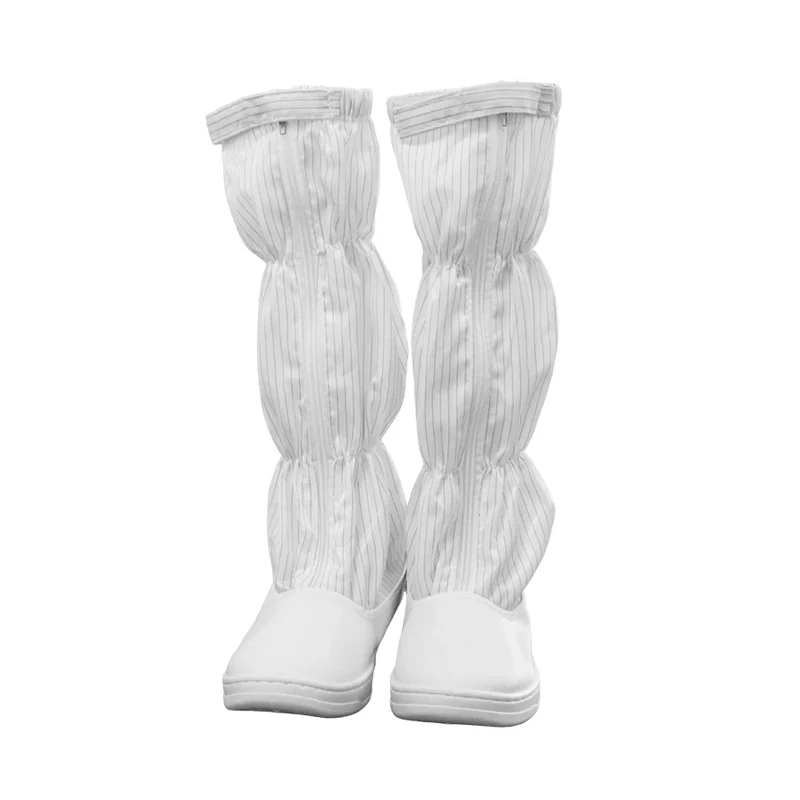
Table of Contents
- 1. Identify the Working Environment
- 2. Check ESD Performance and Test Requirements
- 3. Compare Upper and Sole Materials
- 4. Consider Fit, Comfort, and Daily Use
- 5. Compare Key Selection Factors
- 6. Review Quality Control and Supply Consistency
- 7. Frequently Asked Questions
1. Identify the Working Environment Before Choosing ESD High-top Shoes
When we evaluate footwear for industrial applications, we start with the work environment rather than the shoe design. A semiconductor production area, an electronics assembly line, and a general industrial workshop may have different requirements for electrostatic control, cleanliness, and worker mobility.
ESD High-top Shoes provide extended upper coverage compared with low-cut footwear. Depending on their construction, they may help reduce the entry of dust and loose particles around the ankle area. However, high-top coverage alone does not make a shoe suitable for a cleanroom. Buyers should also consider garment compatibility, particle-control procedures, and the site's footwear requirements.
For electronics assembly and semiconductor manufacturing, the main concern is controlling electrostatic discharge that could damage sensitive components. In pharmaceutical production, precision manufacturing, and other controlled areas, cleanliness and ease of maintenance may also influence footwear selection.
Before placing an order, we recommend confirming the following details with the facility manager or ESD coordinator:
- The required electrostatic control range and applicable test standard.
- Whether the footwear will be used with ESD flooring, grounding systems, or other personnel-grounding equipment.
- Whether the work area has cleanroom or particle-control requirements.
- How long employees wear the shoes each shift and whether they walk, stand, or operate machinery for extended periods.
2. Check ESD Performance and Test Requirements
Electrostatic discharge performance should be verified through product specifications and appropriate test records, not judged by appearance. A shoe may be marketed as anti-static, but buyers still need to confirm whether its electrical properties meet the requirements of their particular workplace.
When reviewing an ESD footwear specification, ask for the applicable test method, measured electrical resistance, test conditions, and acceptance criteria. Depending on the application and market, relevant references may include IEC 61340-4-3 for testing footwear and IEC 61340-5-1 for electrostatic control in electronics environments. The exact standard and limits should be confirmed against the facility's ESD control plan.
It is also important to distinguish anti-static footwear from electrical insulating footwear. ESD footwear is intended to help control static charge; it should not be assumed to provide protection against electric shock or live electrical hazards.
In practice, performance depends on the complete personnel-grounding path. Flooring, socks, insoles, moisture, contamination, and wear can affect measured results. We therefore recommend testing representative footwear under the conditions in which employees will actually use it, where the facility's procedures permit.
3. Compare Upper and Sole Materials
Material selection affects durability, cleaning, comfort, and suitability for different work areas. The best choice depends on the production environment rather than a single material being suitable for every application.
For industrial high-top footwear, upper materials may include artificial leather, PU-coated materials, or canvas. Sole options can include PVC, PU, SPU, and other compounds designed for particular performance requirements. Buyers should request material details for the specific model instead of assuming that all shoes in the same product category have identical properties.
| Component | Common Options | What Buyers Should Check |
|---|---|---|
| Upper | Artificial leather, PU, canvas | Cleanability, abrasion resistance, breathability, and seam quality |
| Sole | PVC, PU, SPU, or other specified compounds | Electrical resistance, grip, wear resistance, and compatibility with the floor |
| Closure | Laces, zippers, or elastic sections, depending on design | Fit adjustment, secure fastening, and ease of putting on or removing |
| Inner construction | Lining and insole options specified by the manufacturer | Comfort, moisture management, cleaning requirements, and effects on ESD performance |
Slip resistance and chemical resistance should also be evaluated separately. A material that performs well in one environment may not suit another, and resistance to particular chemicals should be supported by relevant product data rather than assumed from the material name alone.
4. Consider Fit, Comfort, and Daily Use
Footwear used throughout an eight-hour shift needs to fit properly and remain comfortable during standing and walking. A high-top design can provide additional ankle coverage, but it should not restrict movement or create pressure points.
When assessing samples, we suggest checking several practical details:
- Size consistency: Compare the manufacturer's size chart with the measurements and sizing system used by the workforce.
- Heel and ankle fit: Check for excessive movement, rubbing, or pressure when walking and bending.
- Weight and flexibility: Assess whether the footwear suits the pace of work and the time spent standing.
- Ventilation: Consider indoor temperature, shift length, and whether the work area allows breathable materials.
- Cleaning and maintenance: Confirm which cleaning agents and procedures are compatible with the shoe materials and ESD requirements.
For larger workforces, testing samples across several sizes is more useful than evaluating only one pair. Feedback from employees can help identify fit issues before a full production order is approved.
5. Compare Key Selection Factors
Different industrial environments place different levels of importance on electrostatic control, cleanliness, durability, and comfort. The following table can be used as a starting point when comparing models.
| Application | Main Considerations | Checks Before Selection |
|---|---|---|
| Electronics assembly | Static-charge control and all-day comfort | Electrical test results and compatibility with ESD flooring |
| Semiconductor production | Electrostatic control and contamination management | Facility ESD requirements, cleanroom rules, and garment compatibility |
| Precision instrument manufacturing | Static control, stable fit, and wear resistance | Product specifications and performance after repeated use |
| General controlled production areas | Cleanability, grip, and employee comfort | Cleaning procedures, floor conditions, and required protective features |
These are general selection guidelines, not a substitute for a site's risk assessment. If the job also requires toe protection, puncture resistance, or other occupational safety features, buyers should confirm those requirements separately. ESD performance by itself does not establish that a shoe is safety footwear.
6. Review Quality Control and Supply Consistency
For industrial procurement, evaluating the first sample is only part of the process. Buyers also need confidence that subsequent batches will maintain consistent materials, sizing, construction, and electrical performance.
Dongguan Xin Lida Anti-Static Products Co., Ltd. was established in 2010 and specializes in anti-static products and cleanroom consumables. According to the company's published information, its factory in Dongguan covers approximately 15,000 square meters, including a 10,000-square-meter standard production workshop. The company reports annual production capacity of approximately three million pairs of anti-static shoes, supported by dedicated footwear production equipment and 35 testing instruments.
The company also reports ISO 9001 quality management system certification, a 15-person R&D team, and experience serving customers in electronics, new energy, semiconductor, and other industries. These details provide useful background when evaluating manufacturing capability, but buyers should still review the current certificate scope, model-specific test records, and inspection procedures relevant to their orders.
Before approving a production batch, we recommend documenting the approved sample, size range, material specifications, packaging requirements, inspection criteria, and acceptable electrical resistance range. For repeat orders, retaining sample and inspection records makes it easier to identify changes between batches.
7. Frequently Asked Questions
What industries commonly use ESD high-top footwear?
It is commonly considered for electronics assembly, semiconductor manufacturing, precision instrument production, and controlled industrial environments where electrostatic control is required. Suitability depends on the site's ESD and cleanliness requirements.
Do high-top ESD shoes automatically qualify for cleanroom use?
No. Boot height alone does not establish cleanroom suitability. Buyers should confirm particle-control performance, material compatibility, cleaning procedures, and the cleanroom classification or facility rules applicable to the intended use.
How can buyers verify the anti-static performance of ESD footwear?
Request model-specific electrical resistance test reports and confirm the test method, test conditions, and acceptance limits. Where required, assess the footwear as part of the complete personnel-grounding system used at the facility.
Which sole material is best for ESD high-top shoes?
There is no single best material for every workplace. PVC, PU, SPU, and other compounds may be used depending on the design. Buyers should compare electrical performance, grip, durability, cleaning requirements, and compatibility with the work surface.
What should procurement teams check before placing a bulk order?
Confirm the approved sample, size distribution, material specifications, test documentation, packaging, lead time, and batch inspection criteria. It is also helpful to agree on how nonconforming products will be handled.
Can ESD footwear protect workers from electric shock?
ESD footwear is designed for static-charge control and should not be treated as electrical insulating footwear. Separate protective equipment and procedures are necessary when the job involves electrical shock hazards.
How should ESD high-top shoes be maintained?
Follow the manufacturer's cleaning instructions and the site's ESD control procedures. Inspect the soles, seams, closures, and visible wear regularly, and arrange repeat electrical testing when required by the facility's control plan.
Choosing suitable industrial footwear means balancing electrostatic performance, work-area conditions, material durability, and employee comfort. By verifying specifications and testing representative samples before deployment, buyers can make a more informed decision. With its experience in anti-static products and cleanroom consumables, Dongguan Xin Lida Anti-Static Products Co., Ltd. provides a relevant starting point for evaluating ESD High-top Shoes for industrial applications.